Vision-language grounding 2026 · Preprint
EBV-CAN
Vision–Language Grounding for Contact-Aided Endoscope Navigation
Navigate locally. Keep the global goal in sight.
01 / The idea
Navigate locally. Keep the global goal in sight.
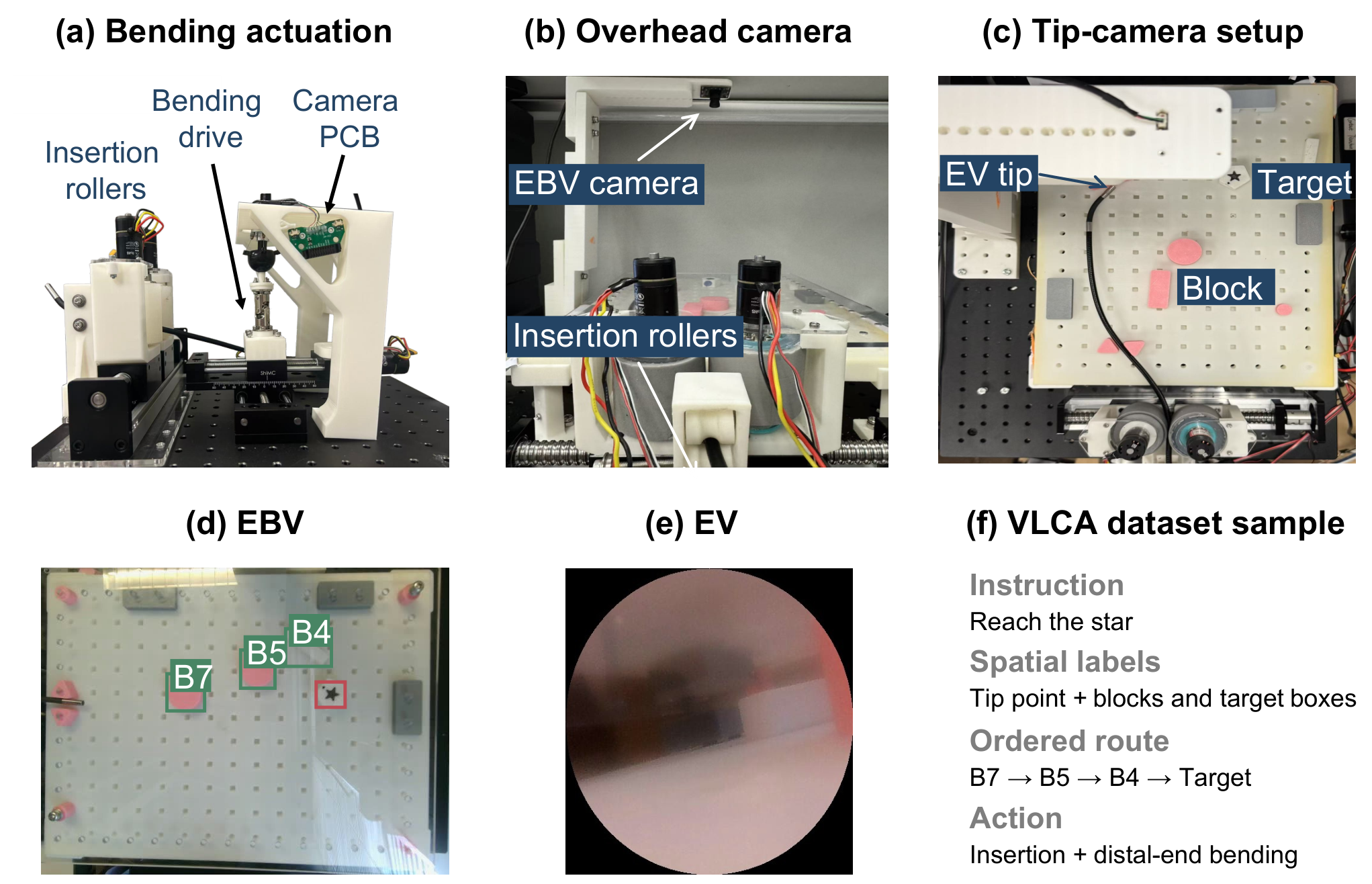
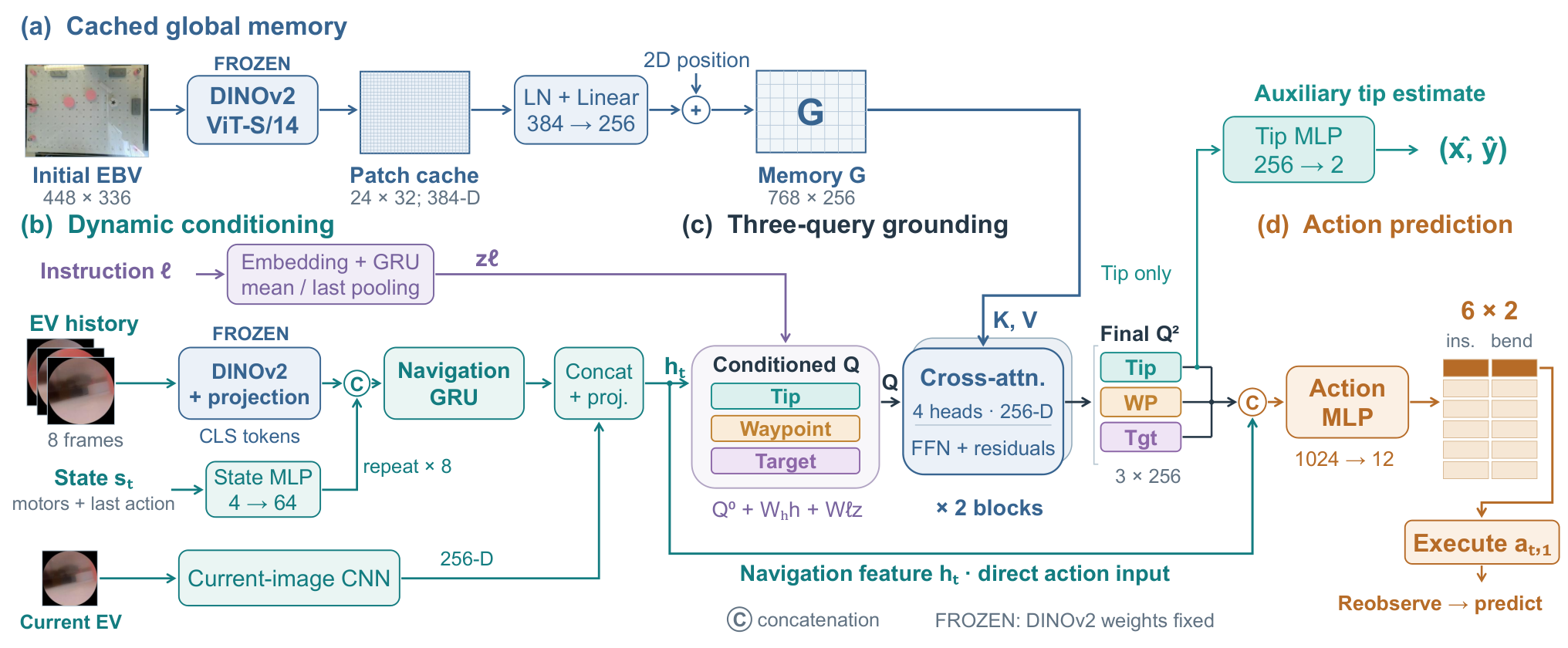
One initial bird’s-eye image provides a fixed spatial reference. Endoscopic observations and motor state update three grounded queries—tip, waypoint and target—to guide bending and insertion through environmental contact.
517demonstrations in VLCA
1,920physical trials · eight policies
76.25%EBV-CAN success · 183/240
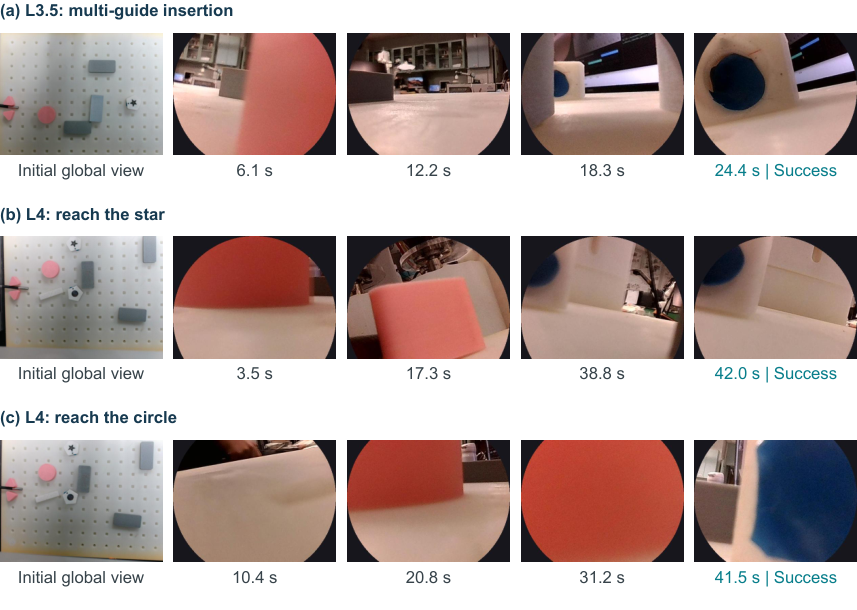
Physical success uses automatic blue-area scoring on the planar contact-aided navigation platform. Evaluation details ↗
02 / The approach
How it works
From observations to a physical outcome.
Remember the scene
Cache the initial bird’s-eye image as a shared spatial reference.
Ground the instruction
Estimate the tip, next waypoint and requested target.
Navigate with contact
Translate grounded representations into bending and insertion commands.
03 / Physical evidence
Inside the experiments
04 / Reference
Build on this work
@misc{ng2026ebvcan,
  title = {EBV-CAN: Vision–Language Grounding for Contact-Aided Endoscope Navigation},
  author = {Chi Kit Ng and Shuchang Liu and Jinsong Lin and Yidong Zhang and Xizi Wang and Ho Yin Chim and Hongliang Ren},
  year = {2026},
  eprint = {2610.30786},
  archivePrefix = {arXiv},
  primaryClass = {cs.RO},
  url = {https://arxiv.org/abs/2610.30786}
}